
Colorado Court Record Requests
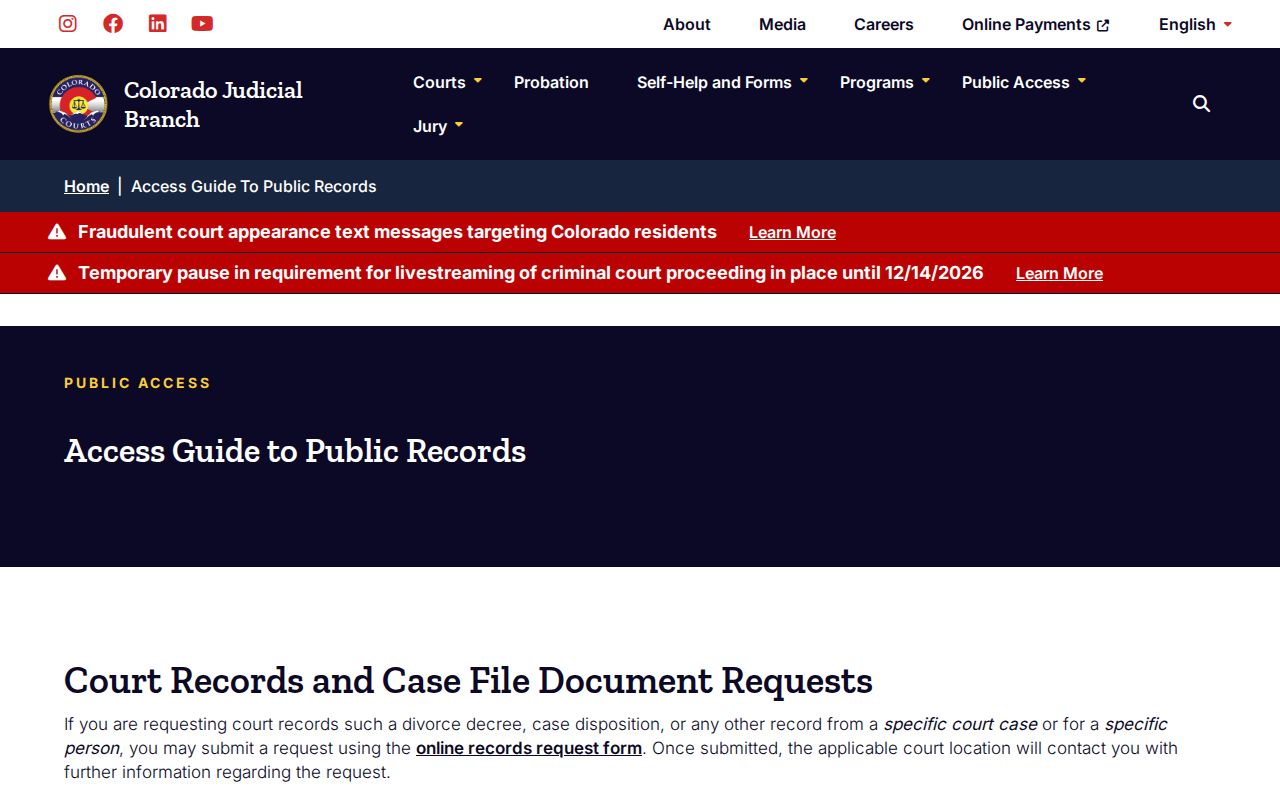
Pick your route based on what you actually need. A docket date, a full case history, a signed order, and a hearing transcript each live somewhere different in Colorado. The Clerk of Court keeps the official file. That is the office in the county where the trial case sits. The clerk, not a website, is the keeper of record. The Colorado Judicial Branch Access Guide sorts the options into a free calendar, a paid ROA link, and local clerk channels for the records themselves. That way you can see which door leads to which document.
Why does the split matter? An online case summary can help you spot the right case number, yet it hands you no filing. Ask what you need first, then match it to the channel.
- For an upcoming state-court setting, use the free Docket Search; it is a calendar, not a file copy.
- For earlier case activity, CoCourts sells a selected ROA summary; eligible filers or parties may have a separate CCE account route.
- For a pleading, order, judgment, or certified copy, use the Judicial Branch Record/Document Request Form or ask the county Clerk directly.
- For counter inspection, a public terminal, a phone question, or a mail request, contact the correct Clerk first; local hours, payment, and delivery methods vary.
- For spoken proceedings or an appeal file, use the court reporter or appellate Clerk rather than treating the ROA as a transcript or appellate record.
Colorado Courts E-Filing, known as CCE, serves filers and parties who hold an account. It is a tool for eligible users, not everyone. The Judicial Branch's non-attorney guidance lays out which self-represented filing workflows a person without a lawyer can use.
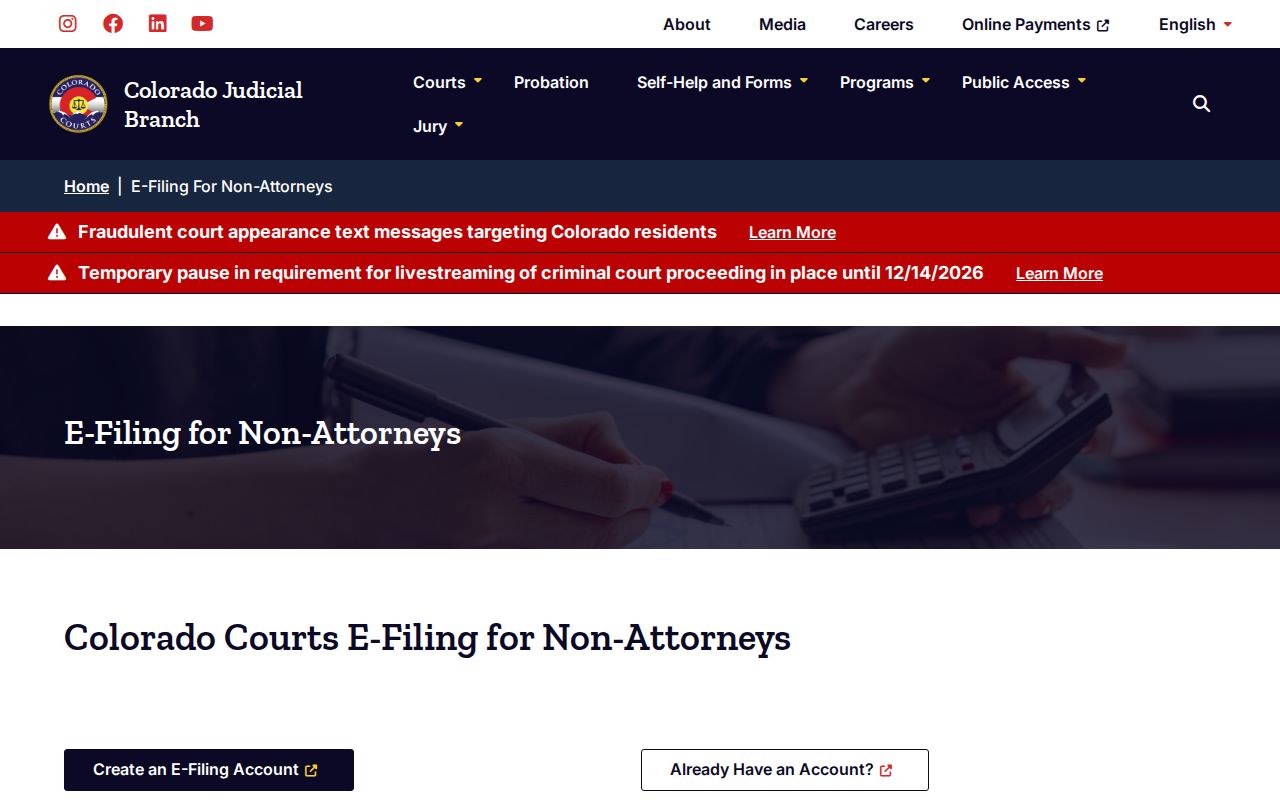
One caution is worth stating plainly. CCE account access is its own lane. It sits apart from ordinary public remote access, and it does not make the system a general browser for court files. For trial-court records, Browse Counties points each request to the local Clerk. Missing the county? The statewide form includes an "I don't know the County" choice. So a blank there will not stop a record request.
Colorado Clerk Holds Court Files
Every Colorado county court operation has a Clerk of Court. In the state's combined-court model, that one office handles records for both District Court and County Court in the county. Filings, docket entries, hearing settings, orders, judgments, payment events, and final dispositions all live there. The State Court Administrator sets policy and runs the technology statewide. It does not hold each county's case files.
Don't mix up this office with the county Clerk and Recorder. That office keeps land records, runs elections, and handles motor-vehicle work. Court business is different. A Colorado court filing goes to the Judicial Branch Clerk of Court. So does a certified judgment, an ROA question, or a request for case copies.
The Colorado Clerk of Court Contacts directory sorts offices by county. It posts local phone numbers and contact details.
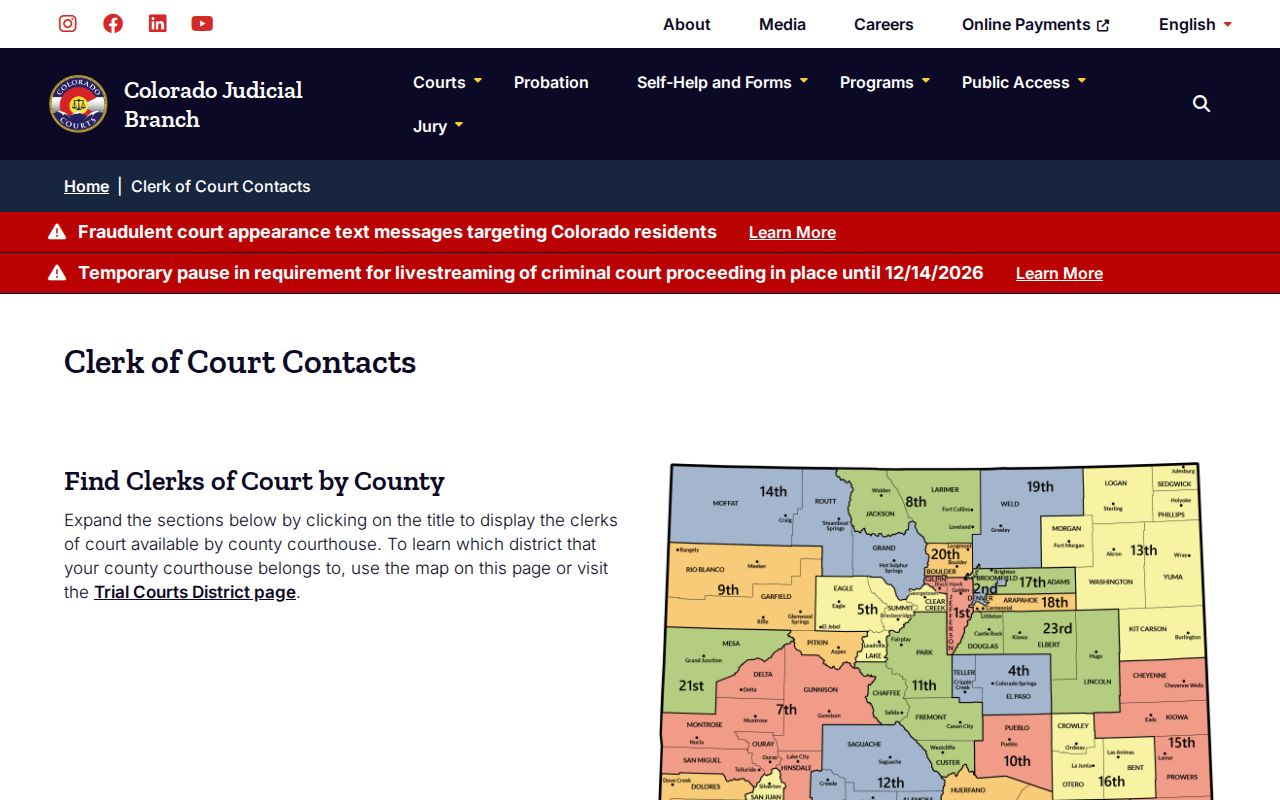
Check the county page before you mail a payment or send records information. It lists the right office, its hours, phone, mailing address, and the request method each clerk accepts.
Colorado Court Record Types
A case file runs wider than its docket or Register of Action in Colorado. The ROA is a short chronological log of filings and court activity. The full file can hold much more. Complaints, answers, motions, exhibits, notices, orders, judgments, returns of service, and minute entries all belong there. One caution: a docket result can show a document title. No public image may be attached for remote viewing.
Some records travel a different route. Spoken proceedings become a court reporter's transcript, and appellate clerks keep the appeal's separate record. Older files may sit at the trial court. They can also move to storage or land at the State Archives. The Clerk can confirm custody before you pay anything for a search or retrieval.
Federal cases sit outside the state system entirely. The U.S. District Court for the District of Colorado keeps its own civil and criminal docket. A separate U.S. Bankruptcy Court handles bankruptcy cases. Federal filings go through CM/ECF, and the public searches them through PACER. No county Clerk can pull a federal case file. Neither the state calendar nor CoCourts covers it. The District of Colorado PACER access page lays out how members of the public reach those federal docket entries and documents.
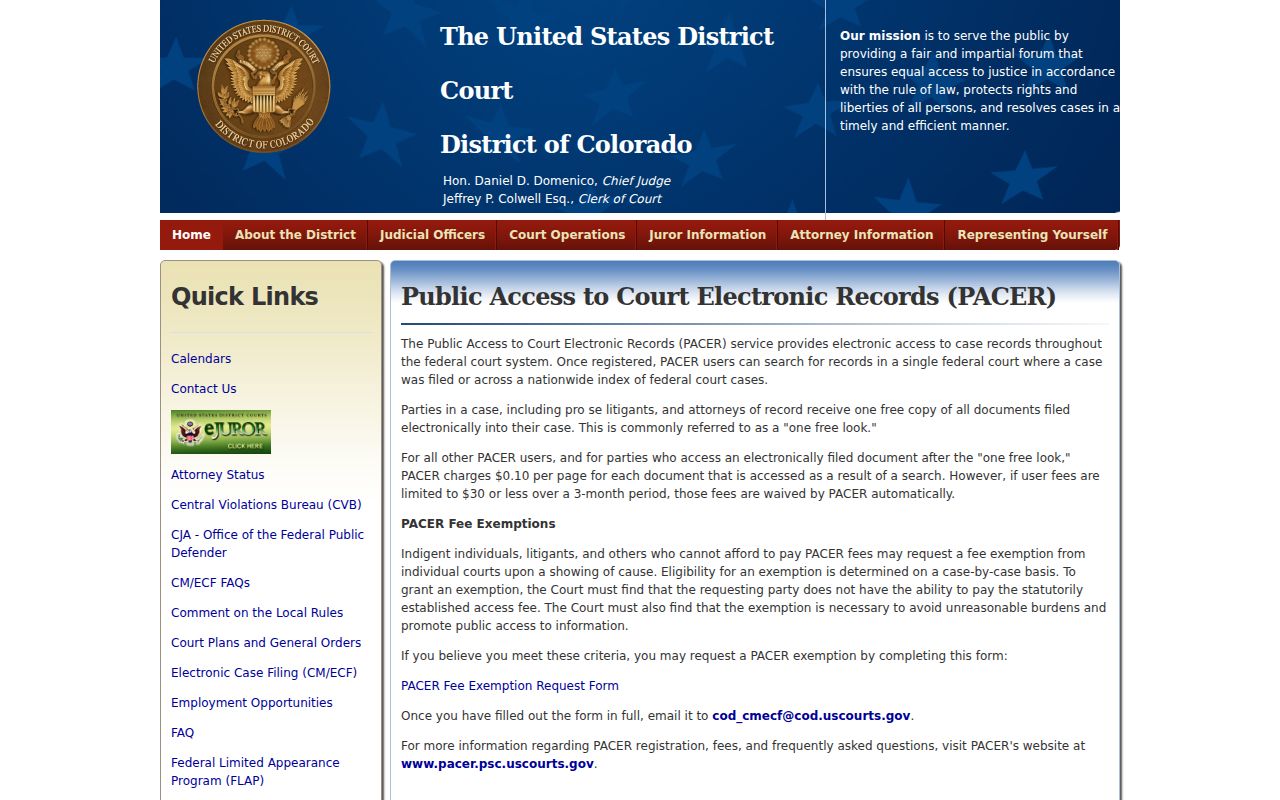
That split federal system is one more reason to check the court named on your document first. Requesting a docket or copy from the wrong level wastes time and fees.
Colorado Court Record Request Form
Colorado's statewide online request form gathers what the clerk needs to pull a court record. Expect to give contact details, the party name, the type of record, and the court location. There are also boxes for a case number. Case type, year filed, and the county or court have their own fields too. Pick a county unless you can honestly check that the county is unknown. Date of birth and similar identifiers stay optional. Share sensitive details only when the court itself asks for them.
Name the document you want whenever you can. The form covers divorce decrees, parenting plans, separation agreements, support orders, complaints or informations, disposition and sentence orders, protection orders, tickets, judgments, satisfaction certificates, probate records, and the ROA, plus an "Other Documents" option. Asking for a whole case file means far more search, copy, and redaction work than asking for one named order. A narrow docket request usually moves faster.
| Form Field | Control | Requirement or Use |
|---|---|---|
| Requester | Name and contact fields | First and last name, email, phone, and mailing address are required; middle name and business are optional. |
| Case Number | Text | Optional; the format uses a two- to four-digit year, one or two letters, and a sequence of one to six digits. |
| Case Type and Year | Dropdowns | Optional; year choices run from 2026 back to 1873. |
| County or Location | Dropdown and checkbox | Required unless “I don’t know the County” is checked. |
| Party Name | Text | Required for a name-based lookup; enter the party named in the case. |
| Date of Birth / Other Details | Date and text | Optional or used when known to help locate a record. |
| Document Choices | Checkboxes | Choose at least one record type, including the ROA or a named filed item. |
| Certified / Exemplified | Checkbox | Optional; select when formal authentication is needed. |
On the Colorado Record/Document Request Form, one checkbox tells the clerk whether the copy must be certified or exemplified.
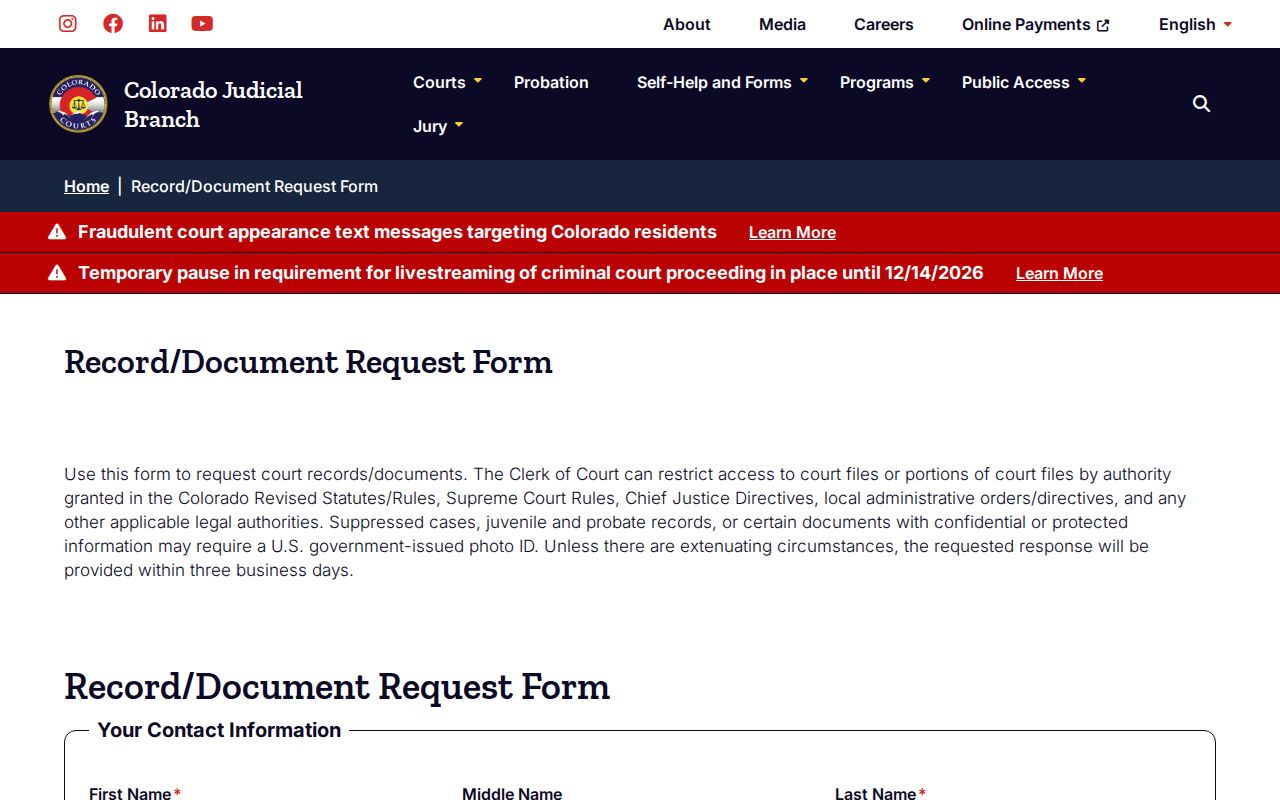
The form sends your request straight to the court location that holds the file. No state office sits behind it keeping every Colorado trial record on hand.
What a Colorado Court Record Holds
A Colorado ROA is a short summary of case activity. The full court file may hold the papers behind those entries. The entry is not the paper, though. A line saying motion granted does not include the motion or the signed order. A docketed judgment does not prove a vendor extract is certified, either. When the online record names a filing but shows no image, request that item by case number, date, and description.
Two fields anchor retrieval. They are the Clerk's case number and the court location. Also know the record type. A transcript is a written account of spoken proceedings. The Clerk's register, by contrast, lists filings and court actions.
| Case identifier | Case number, court, county or location, party name, and case type. |
|---|---|
| Register of Action | Brief chronological entries for filings, settings, orders, and disposition; an index, not the full file. |
| Pleadings and motions | Filed papers such as a complaint, answer, motion, or response. |
| Orders and judgments | Written court directives and formal decisions; ask for the signed item when needed. |
| Other filed material | Notices, returns of service, exhibits, minute entries, and other documents retained in the case. |
| Transcript or recording | Spoken proceedings use a separate reporter and access process, not the ordinary docket copy. |
An online entry is not the document itself. Remote access rarely shows every filing. For a Colorado trial record, the Clerk can say whether an image is available, must be redacted, or needs a formal request.
Colorado Copies Differ by Authentication
Copies come in three grades. A plain copy is just for reading and reference. A certified copy carries the Clerk's certification for one particular document. An exemplified copy adds a higher form of authentication, sometimes demanded for use outside Colorado. None of these labels authenticates a search result. Nor does it authenticate a case summary or a whole vendor database. Before ordering, ask the receiving court or agency which form it requires.
The Colorado Clerk may provide a copy by the available local method. A transcript comes from the reporter instead. A federal document comes from the federal court system. Fees and delivery times differ. A scanned image, a plain copy, a certified copy, and an exemplified copy each carry its own charge.
The CoCourts pricing page lists a separate fee for a vendor ROA search. That charge buys a case-history query, not a court copy.
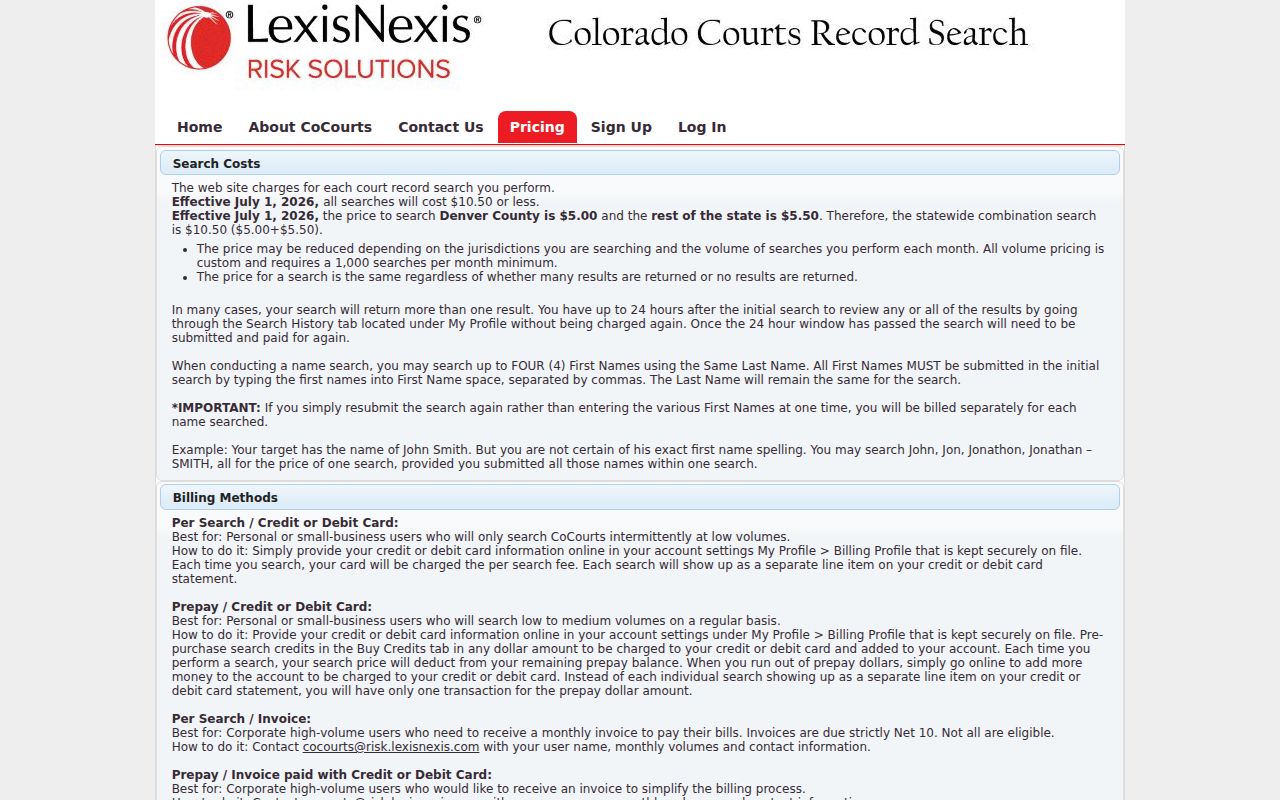
Keep the vendor’s per-search charge separate from the Clerk’s statewide copy and certification schedule.
Court Record Fees in Colorado
Colorado sets statewide base charges for copy work. Plain-copy pages run $0.25 each. A party or attorney request tops out at $15, while a non-party request has no cap. Certification or exemplification costs $20 per document, and page charges may still apply. These are court-record charges, not the vendor search fee or a CCE filing fee.
Some requests carry a fixed amount. Others depend on retrieval and staff work. The state form says replies normally issue within three business days unless an extenuating circumstance occurs. Treat that as a response estimate. It does not promise an archived file, a transcript, or a redaction will be done in three days. Confirm the total and the accepted payment method with the Clerk before mailing funds.
| Record or Service | Published Amount | Scope |
|---|---|---|
| Plain copy | $0.25 per page | Party/attorney maximum $15; no non-party cap |
| Certified or exemplified copy | $20 per document | Page-copy charges may also apply |
| Transcript of judgment | $25 | Named document fee |
| Certificate of satisfaction | $20 | Named document fee |
| Name search | $5 | Case-location search fee |
| Off-site file retrieval | Actual cost | Amount depends on the file and storage |
| Research or redaction | $30 per hour | 15-minute increments after the first hour |
Colorado allows fee waivers in some cases. They rest on court law and the applicable directive. A court can also add local postage, handling, or archive costs, so the statewide schedule is not a complete quote for every file.
Colorado Court Transcripts Come From Reporters
A transcript is a written record of what was said in court. It is not a copy of the ROA. Colorado's JDF 4 request asks for plenty: case number, county, case title, division or courtroom, judicial officer, transcript type, and whether the request serves an appeal, plus contact details. The reporter then contacts the requester with a cost estimate and payment instructions. A nonparty may need approval from the court executive or chief judge.
The CJD 05-03 schedule, effective July 1, 2023 caps page rates. Ordinary work runs $3.60 a page. Expedited is $4.35, overnight or daily is $5.85, and hourly service is $6.85. Delivery standards vary by service level. Ordinary work runs 30 days. Overnight or daily service arrives the next day. Hourly delivery comes within two hours after adjournment. The rate alone tells you neither the page count nor the total bill. Reporter availability affects timing, too.
The Colorado JDF 4 transcript request form lays out the details a reporter needs to locate a proceeding. Fill it in carefully.
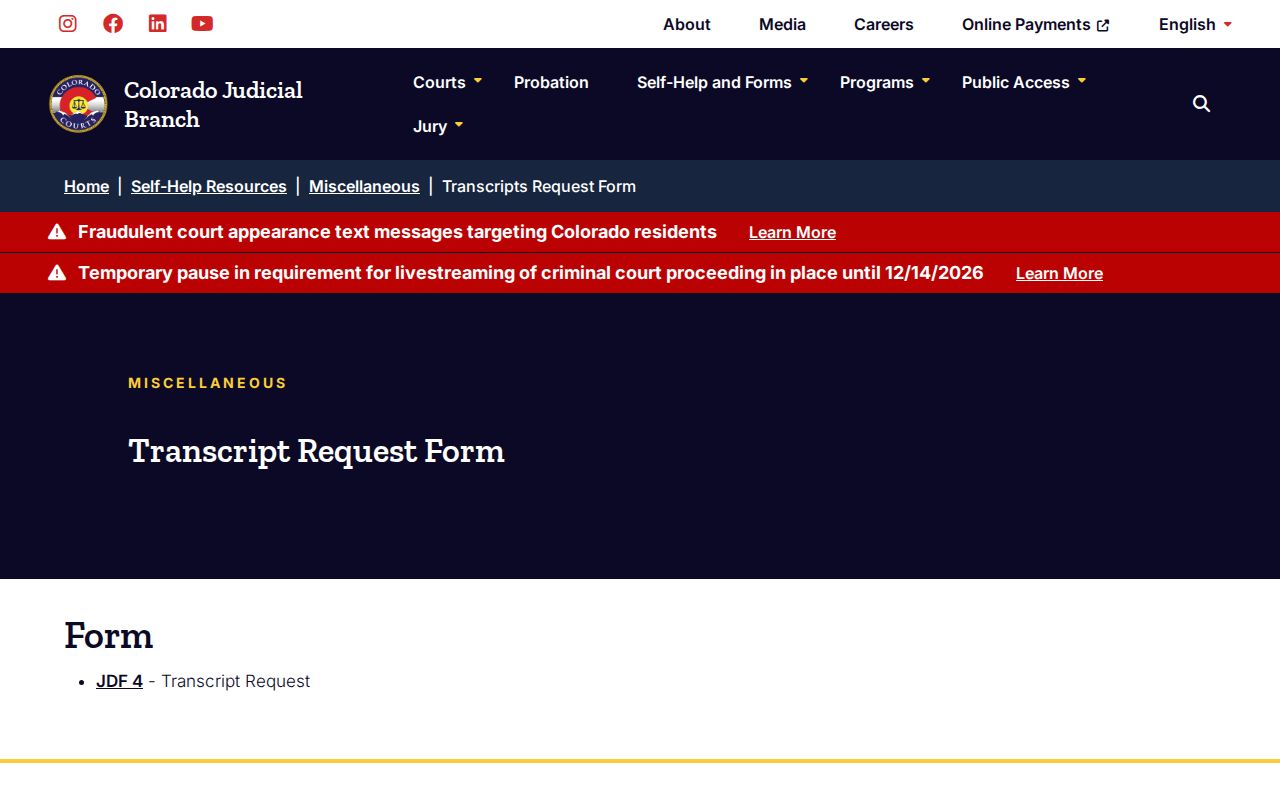
Give the hearing date and court details as exactly as possible, so the reporter can find the right audio record. Accuracy matters here.
Colorado Record Access and Sealing
Colorado starts from public access to court records. Access is still bounded by law, directive, and court orders. Remote viewing is narrower than walking into the courthouse. Under CJD 05-01, remote systems restrict detailed financial data, free-text fields, addresses, phone details, victim and witness information, and some documents. Sealed, suppressed, restricted, limited, and protected records follow different rules. A protected document may simply be redacted. A sealed file can require an exception or an order. Juvenile and certain probate records carry added limits. The Colorado Open Records Act covers general government records, but a court file follows CJD 05-01 and PAIRR Rule 1.
Key Rules: CJD 05-01 sets remote case-record and redaction limits; PAIRR Rule 1 governs access to court records. The Colorado Open Records Act covers general government records, and the Children’s Code sets juvenile confidentiality rules.
The Colorado Sealed Case Search serves one narrow purpose. It lets a person check for certain automatically sealed conviction records in their own case.
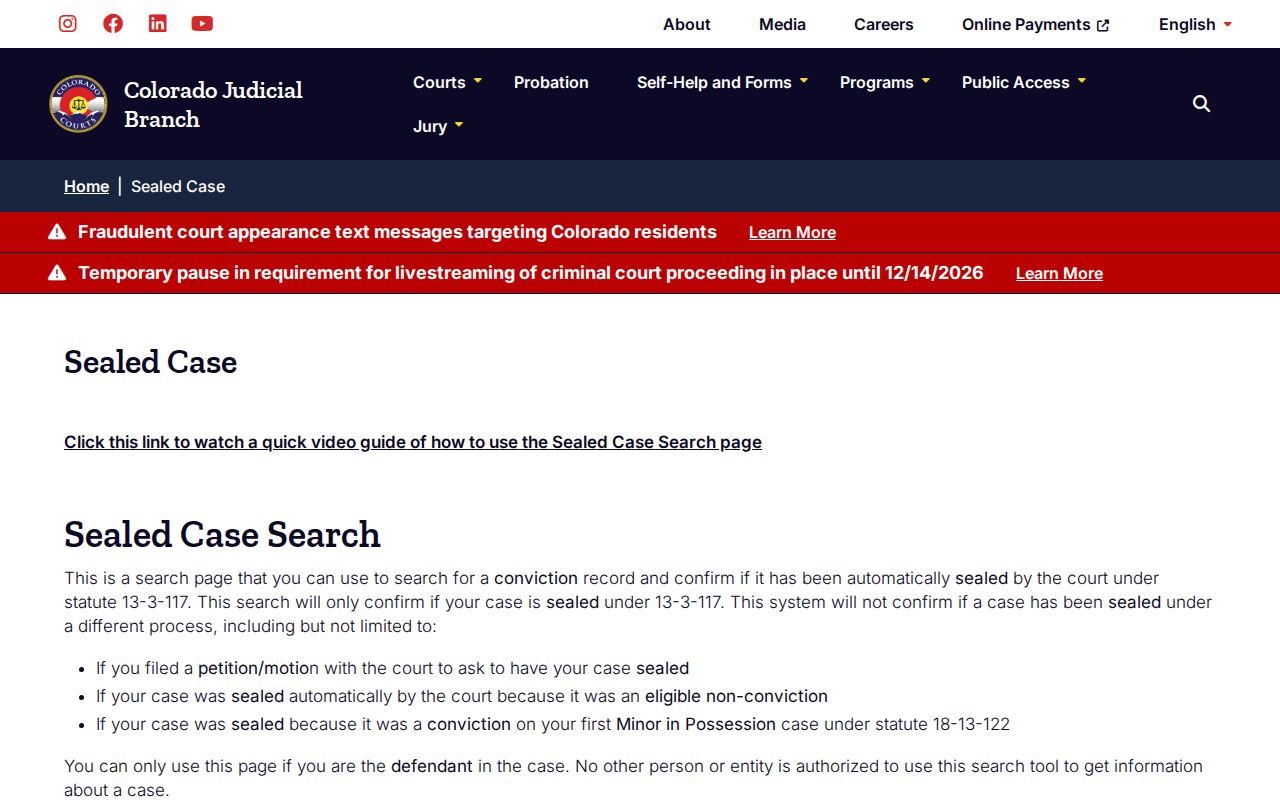
It requires case details and identity matching. It is not a public name-search tool for another person's sealed history.
Colorado's Older Court Files
Older case files in Colorado travel. A trial case might sit with the current Clerk, wait in off-site storage, or live at the State Archives. Ask the Clerk to trace the record-retention path first. Do not assume an archive already has it. Retention schedules only describe timing. The manual cannot prove any single file survived or moved. The State Archives court-record finding aids list historical collections too, but indexing a collection is not the same as confirming your file is in it.
Appeals build a second record. A trial-court ROA may note a notice of appeal, record prep, and a transfer out, yet the appellate file itself stays with the Supreme Court or Court of Appeals Clerk under a new appellate case number. The Supreme Court also warns that records created before 2014 often live only at Colorado State Archives. Decision pages serve up selected opinions. They are not a live docket event, and they are not a certified copy.
For the appellate route and that archive note, the Colorado Supreme Court Clerk's records and fee page spells it out.
Know which record you need before you call. For an appellate copy, pinpoint the appellate case and the exact item wanted; for a trial record, start with the county Clerk holding the original case file.